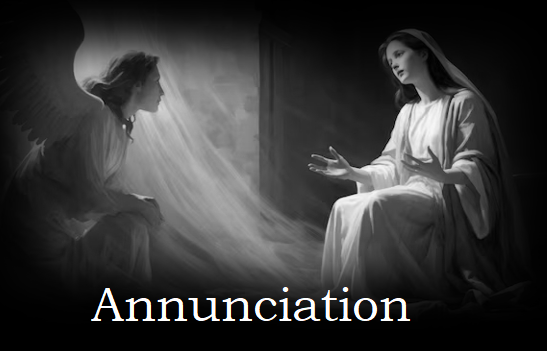
Annunciation
Our Lady’s total surrender to God’s will, at the Annunciation, shows the essence of all Christian vocation: to say “Yes” to God in all things, and to trust and believe he will fulfill his promises.
God created us in his own image and likeness, to know Him, love Him and to serve him in this world, and to be happy with him forever in heaven, to which he calls us all.
In Genesis we are told that God revealed himself to our primary parents, Adam and Eve, so that they might know him and enjoy fellowship with him.
But when they, our first parents, disobeyed God thus separating the human race from its creator, God did not stop revealing himself to us, nor forget his plan that we be with him in heaven.
A new Eve would crush the head of the serpent who had tempted the first Eve and thereby brought sin into the world.
During mankind’s long wait for the promised saviour, God spoke to his chosen people Israel through the patriarchs and prophets, renewing again and again his promise to redeem them, even in the face of their repeated disobedience, or saying “No” to God.
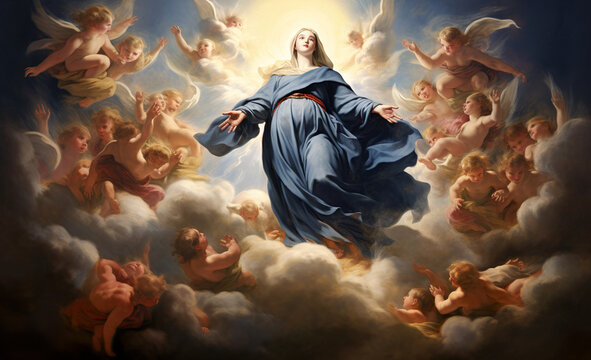
Finally, at the appointed time, God sent his messenger to a young Jewish woman, Mary of Nazareth, and His word became flesh.
The angel Gabriel addressed Mary, “Hail, full of grace” (Luke 1:28). No human being had and has ever been addressed so highly by God. Through Gabriel, God made a momentous request to Mary, to bear the “Son of the Most High” (Luke 1:31-32); to be the mother of Israel’s Messiah.
At first Mary was puzzled. “How can this be, since I have no husband?” (Luke 1:34). She didn’t doubt, but wanted to grasp something holy and mysterious. Gabriel simply assured her that nothing is impossible for God (Luke 1:37). The Holy Spirit would overshadow her (1:35). She would conceive and bear the Son of God. Gabriel said the child will be called Jesus (Luke 1:31), meaning, “The Lord saves”.
“The Lord God will give to him the throne of his father David, and he will reign over the house of Jacob forever; and of his kingdom there will be no end” (Luke 1:32-33).
Mary understood little of what this meant for her, but believed and gave her complete assent: “Behold, I am the handmaid of the Lord; let it be done to me according to your word” (Luke 1:38). This is Mary’s “Fiat”, a Latin word that means “Let it be done”, in a word, saying “Yes” to the Lord. It was spoken from a heart filled with pure love for God and allowing God to use her that his will be done.
While Mary knew from scripture the prophetic promises of God, and longed to see them fulfilled, she little understood what bearing the Messiah implied for her. But she said Yes to it anyway in complete trust in God. That is the very definition of faith.
Mary knew God is faithful, and trusted He would keep His promises. Her unshakeable faith in God gave her the courage to submit to His will.
In our fallen nature, Mary’s “Yes” changed the course of human history, and also transformed her forever by the Word becoming flesh within her.
From being a simple girl in an unknown village in Nazareth, she was bestowed the highest honour possible – being the mother of God’s son. All because she heard God’s call and obeyed it.
Mary’s “Yes” would be repeated over and over in the days and years ahead. Her steady pondering of the word of God, repeatedly assenting to God’s purposes revealed through it, would carry her forward in unwavering faith and obedience.
In the Church’s catechism we read: “By pronouncing her “fiat” at the Annunciation and giving her consent to the Incarnation, Mary was already collaborating with the whole work her Son was to accomplish. She is mother wherever he is Saviour and head of the Mystical Body” (Catechism of the Catholic Church # 973).
The Annunciation reveals the meaning of the Christian vocation. “I am the handmaiden of the Lord; let it be to me according to your Word.” It is in these words that we discover the vocation of every Christian.
Mary teaches us how to say “Yes” to the Father who created the world and is recreating it through His Son; to say “Yes” and believe that “nothing is impossible with God.”
As with Mary, God invites us to say “Yes” in freedom that is both human and divine: human by nature, divine by grace. We all can say “Yes” to God in surrendered love, thus beginning our dwelling in the very life of God who is Father, Son and Holy Spirit.
We become sons and daughters of God, who transforms us by His continual grace, and in whom we find our real selves.
Our holiness comes through first saying “Yes” to God. Centuries of saints in the Church have learnt that as we lose ourselves in God, He makes it possible for us to have a genuine relationship with Him.
Mary’s fiat does not just compel our veneration of her, but also our imitation. Just as she submitted to the will of God, so also are we called to say our own “Yes” to the will of God.