Body and soul
The Blessed Virgin Mary, the mother of our Lord Jesus Christ, the mother of God, is the most highly honoured member in the communion of saints.
Mary freely and actively cooperated in a unique way with God’s plan of salvation (Luke 1:38; Gal. 4:4). She was never separated from the suffering of her son (Luke 2:35), and Scripture promises that those who share in the sufferings of Christ will share in his glory (Rom. 8:17). Since she suffered a unique interior martyrdom, it is appropriate that Jesus would honour her with a unique glory.
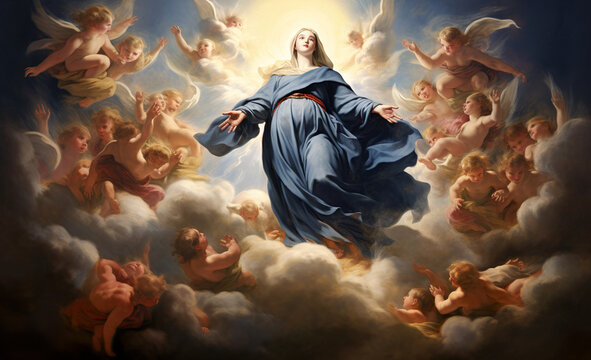
As the Catechism states: “The Most Blessed Virgin Mary, when the course of her earthly life was completed, was taken up body and soul into the glory of heaven, where she already shares in the glory of her Son’s Resurrection, anticipating the resurrection of all members of His Body” (974).
The Assumption of Mary is the oldest feast day of Our Lady, and began in Jerusalem shortly after her death there, believed to have happed somewhere around 40 AD.
Mary’s tomb is near the Garden of Gethsemane in the Kidron Valley, and a short distance from where she lived next to the Church of the Last Supper, so that she might be close to Jesus in the Eucharist.
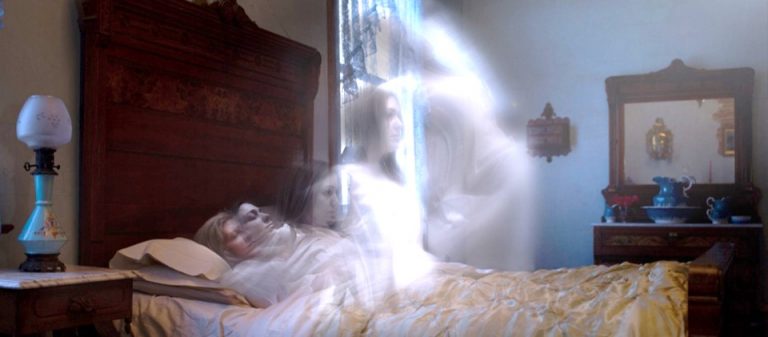
The Church of the Dormition is now over what was her home. Dormition means Mary’s “falling asleep”, which is a way of describing the utter peacefulness of her passing away.
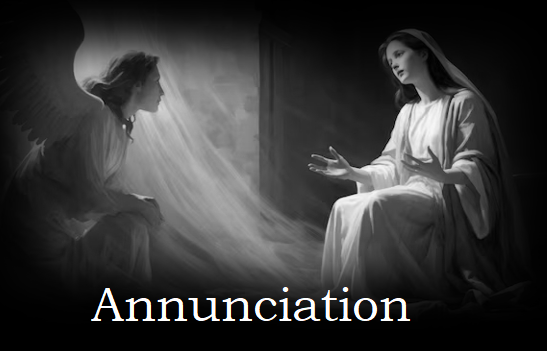
The angel Gabriel had made known to Mary that her time of Earth was short, and she prayed to see the Apostles one last time. All were away on missions, except James. When they had returned, Mary addressed and blessed each one before passing away.
Thomas, however, arrived three days after Mary was interred in her tomb. And when the tomb was opened for him, it was found to be empty.
The feast of the “Memory of Mary,” in and around Jerusalem, that celebrated the belief that Mary had been taken up, body and soul, into heaven, soon came to be called the “Assumption of Mary”. The feast of the Assumption came to be celebrated throughout the Church by the eighth century.
In some of the early literature, there is legitimate disagreement about whether or not Mary died before being assumed. However, there is no disagreement as to whether or not she was assumed.
From the first century, Christians gave homage to saints. In the early Christian centuries relics of saints were zealously guarded and highly prized.
At the Council of Chalcedon in 451, Emperor Marcian asked the bishop of Jerusalem to bring the relics of Mary to Constantinople to be enshrined in the capitol.
The bishop explained to the emperor that there were no relics of Mary in Jerusalem, that “Mary had died in the presence of the apostles; but her tomb, when opened later … was found empty and so the apostles concluded that the body was taken up into heaven.”
Homilies of the early Church Fathers show us how and what the Church believed in the Assumption of Mary. St. John of Damascus, who preached a number of times at the site of Mary’s tomb at Gethsemene, spoke of the Assumption in the context of the Mystery of the Incarnation, stressing Mary’s role in the divine work of our salvation.
The Incarnation — God taking on human flesh — is the central event in all human salvation, the ground of all human hope for life beyond death, and the story of Mary’s transformation is no exception to that theological rule.
As the first human to share directly in the life and grace of the Incarnate Word on earth, she must be understood to be the first to share his eternal life. Freedom from corruption and from the power of death forms an inseparable part of the trajectory of her whole life. Her association with the risen Jesus, in whom the Kingdom of God has now come in its fullness, seems also to be the reason St John of Damascus so frequently identifies Mary with the royal bride of Psalm 44, and establishes her permanently as humanity’s intercessor and patron, its human intermediary with the risen Lord.
Belief in the Assumption of Mary has existed in the Church since the first century, at the time of the apostles. Yet it was not until 1950 that this was defined infallibly as a dogma of the Catholic faith, in Pope Pius XII’s apostolic constitution, Munificentissimus Deus, Latin for “The most bountiful God.”
Most simply stated “the Immaculate Mother of God, the ever Virgin Mary, having completed the course of her earthly life was assumed body and soul into heavenly glory” (Pope Pius XII, MD 44).
It is important to note that, unlike with Jesus her son, Church teaching does not use the terms “resurrection” or “ascension” to define or describe the “assumption” of Mary. She was not “raised from the dead” or “brought back to life” on earth, nor did she “ascend into heaven by her own power.” Mary was “assumed into heaven, body and soul” by God at the end of her earthly life.
There are passages in Scripture that resonate with the Assumption, even though they do not spell it out.
Church teaching identifies Mary in the Book of Revelation as the one “who brought forth a male child, one who is to rule all the nations with a rod of iron … [the one] caught up to God and his throne” (Rev 12:5).
Certainly, the woman in Revelation is a symbol for the Church, the Bride of Christ (Gal 4:26; Eph 5:31–32). But she is also its mother with “offspring” in addition to the one male child to whom she gives birth. And those children are described in Revelation as those who believe in Jesus.
Mary’s Assumption is reflected in the Old Testament. In Psalm 131: “Arise, O Lord, into your resting place: you and the ark, which you have sanctified.” Psalm 44:10-14ff offers a fitting description of Our Lady as the Queen entering triumphantly into the royal halls of heaven and sitting at the right hand of the divine Redeemer.
The possibility of a bodily assumption before the Second Coming is suggested by Matthew 27:52–53: “[T]he tombs also were opened, and many bodies of the saints who had fallen asleep were raised, and coming out of the tombs after his resurrection they went into the holy city and appeared to many.”
John Paul II noted: “Although the New Testament does not explicitly affirm Mary’s Assumption, it offers a basis for it because it strongly emphasized the Blessed Virgin’s perfect union with Jesus’ destiny. This union, which is manifested, from the time of the Savior’s miraculous conception, in the Mother’s participation in her Son’s mission and especially in her association with his redemptive sacrifice, cannot fail to require a continuation after death. Perfectly united with the life and saving work of Jesus, Mary shares his heavenly destiny in body and soul.”
All Christians believe that one day we will all be raised in a glorious form and then caught up and rendered immaculate to be with Jesus forever (1 Thess. 4:17; Rev. 21:27). As the first person to say “yes” to the good news of Jesus (Luke 1:38), Mary is the prototypical Christian and received early the blessings we will all one day be given.